|
 |
|
• WTO Project: “Russia´s WTO policy: A moving target...”
•
“Post-Soviet Conflicts
Revisited?..“
•
EURUS Project: “Legal Culture in the
EPR Area...“
•
Kazakhstan Project: “Modern Kazakhstan –
Images and...“
•
Islam Project: “Will Russia Become
a Muslim Society?..“
•
Comparative Cultural
Studies...
|
 |
|
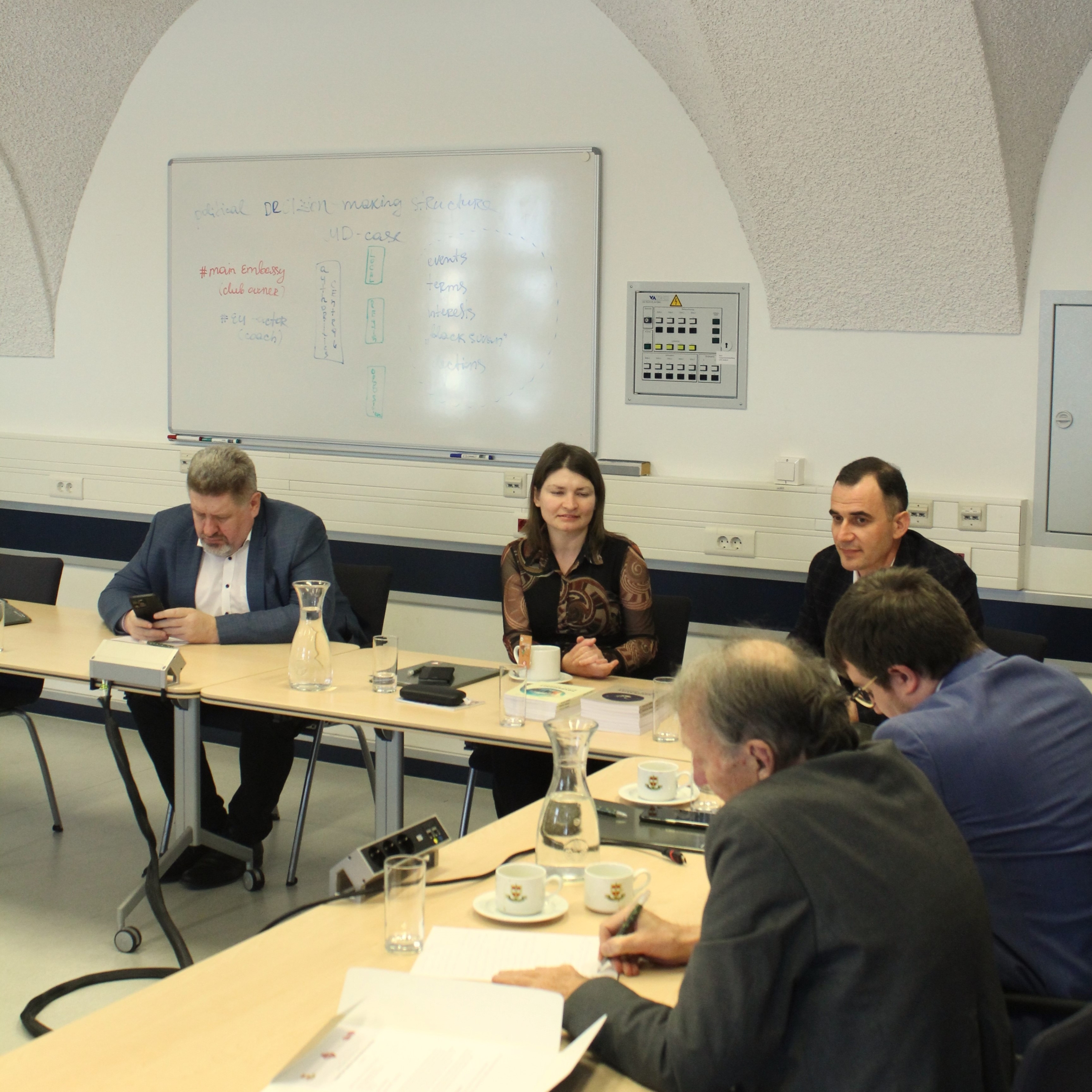
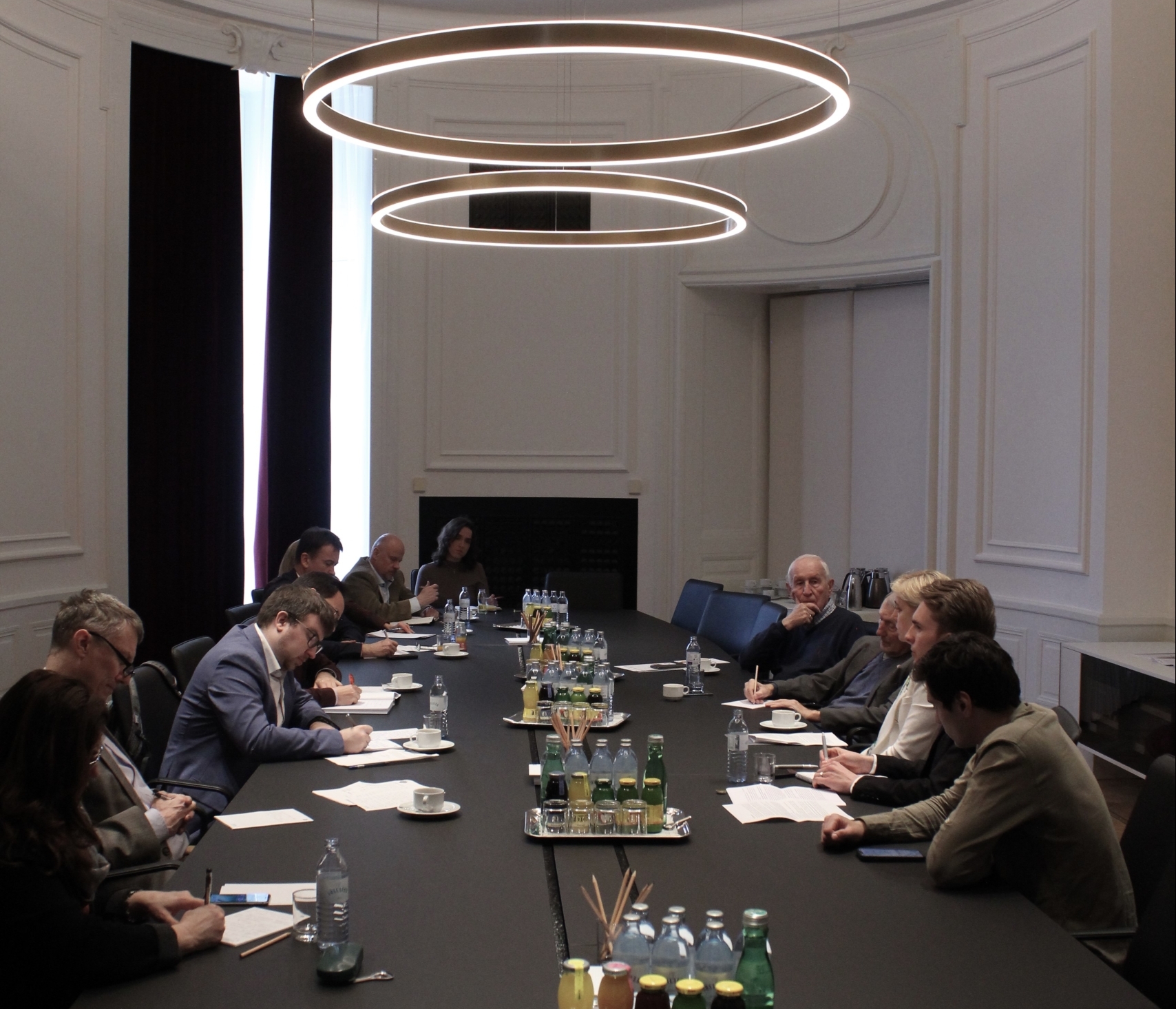
VIENNA PROCESS: Major results of the 4th expert meeting
Read more
The Vienna Process is an NGO-based venture which draws on the professional knowledge of a pool of Russian and European experts with
different backgrounds and institutional affiliations, who share the objective of improving the relations between Russia and the EU.
Its format and working mode profits from the flexibility and independence of international civic initiatives which are not tied down
by high-level politics and institutional constraints, but can also rely on their collective knowledge of relevant institutional practices.
The Vienna Process will generate a series of policy recommendations focusing on feasibility and viable solutions.
EU-Russian relations are currently in a business-as-usual mode: A new Cold War which is sometimes conjured up is a distant bugbear and
the post-1991 heyday a distant memory. The virtual standstill of the various dialogues, especially in the field of energy and security, is
due to different priorities of both partners and to the habit of setting advance conditions in tit-for-tat deals: the energy dialogue is
stalled because of the conditionality that Russia join the WTO first. The security dialogue is hobbled by the Russian priority to nest NATO
into a new system of European security. In both cases, the preconditions are ultra vires for the other partner, at least for the time being.
The dialogues should be maintained, even if they do not yield immediate and tangible results. They imply permanent contacts and the opportunity to improve mutual understanding.
However, it is equally important to support processes and initiatives which are under way in the wake of or independent of the official dialogue channels. They concern “hard” and “soft” areas such as
• Security: Trust-building measures in terms of further joint peace-keeping missions or political
support for civic initiatives in conflict areas (Caucasus, Moldova) are possible and important
• Economy, business: More first-hand practical knowledge and know-how should be fed into the high-level dialogue
• Education and human contacts: There is a multitude of grass root civic initiatives to make people from EU member
states and Russia meet in the framework of joint educational or internship programs. These initiatives should be strengthened, particularly through facilitating visa procedures for students.
Read more
|
 |
|
Current projects
•
Legal Culture in the EPR Area: Realizing a priority of the Austrian Foreign Trade Concept
•
Adoption and Implementation of the European
Charter of Basic Rights (ECBR) in Kazakhstan
•
Muslim identity in an open society: the case of Chechen refugees in Austria
•
Problems and practices in EU-Russian business
•
Russian concepts of state and law: As a first issue of the ICEUR Insight Studies
|
|
|
Projects under expert review
•
Kazakhstan in Flux: Chances for Europe
•
The Elites in Belarus and their Attitudes Towards Democratization, Economic Liberalization and Closer Relations With the EU
•
Totalitarianism, Populism and Democracy
•
The ICEUR Dialogue: Studies in Euro-Russian Conceptual History
|

ICEUR is committed to the organization of educational programs as a means to advance cross-cultural learning and understanding, mutual knowledge transfer and mobility.
ICEUR seminars and training sessions address primarily students and academic staff and are held in both Austrian and Russian locations. They are organized jointly with
such prestigious academic institutions as Moscow State University, the Higher School of Economics (Moscow) and the Russian State University of Humanities (RGGU). As a
collateral effect of this co-operation, the exchange of research and teaching staff is promoted and joint research projects initiated.
ICEUR training seminars address a wide range of interested groups and have a flexible and customized format. Specialized fact-finding seminars and on-site internships
are offered to business people, journalists or administrators. Capacity building programs for professionals from NIS countries cover such issues as European legal and
political standards or the European experience in building civil society. ICEUR has started its educational programs with two summer schools in Moscow held in July and
September, 2009, in Moscow.
Read more
|
|
 |

|
ICEUR Studien #2-2011
RUSSISCHE DEMOKRATIE ZWISCHEN MEHRHEIT UND MACHT
Read more
|
|

|
ICEUR Studien #1-2011
RUSSIA & THE WTO: NEW OPPORTUNITIES FOR EUROPEAN BUSINESS
Read more
|
|

|
Working Papers #4
RUSSIA AND THE WTO:
EXPERT DEBATES AND CONTROVERSIES
Read more
|
|
 |
H.-G. HEINRICH, L. LOBOVA, A. MALASHENKO
Will Russia Become a Muslim Society?
The somewhat provocative title of this volume relates to the lingering fears of Islamization which are widespread also in Russia.
Read more
|
|

|
Working Papers #3
EU-RUSSIA NEW DEPARTURES AND OLD HABITS
Read more
|
|
 |
H.-G. HEINRICH, L. LOBOVA (eds.)
Belarus: External Pressure, Internal Change
This volume is a synopsis of various perspectives
as well as a trans-boundary and interdisciplinary analysis
of the Belarusian model.
Read more
|
|
 |
Working Papers #2
CRITICAL OPTIMISM: RUSSIA AND EUROPE COPE WITH THE CRISIS
Read more
|
|
 |
Working Papers #1
BACKGROUND, SHAPING FACTORS AND ORIENTATIONS OF RUSSIAN FOREIGN POLICY- INSIDE VIEWS
Read more
|
|
 |
K. TANAEV, H.-G. HEINRICH, ICEUR Team, FEP Team
Georgia & Russia:
Contradictory Media Coverage of the August War
As a first contribution to ICEUR’s media work stream, a joint ICEUR-FEP
team has authored a research
paper on “Contradictory Coverage of the August War”
Read more
|
|
|
|
|
|
|
|
 |
|
Apart from its publications, ICEUR´s information activities include spot analyses on current problems and hot
issues in EU-NIS relations. Top experts from EU and NIS countries as well as ICEUR staff writers are among
the contributors. The focus of these analyses is on structures and structural change as opposed to comments
on current events.
Sergey Kulik. Institute of Modern Development (INSOR). Cooperation between Russia and the EU in the CIS economic space.
The groundbreaking INSOR initiative: authorized abridged version.
Read more as PDF
Andrey RYABOV. Russian Modernization Strategy: Political Goals, Realities and Constraints.
Read more
Alexey MALASHENKO. Islam in Russia: Religion and Politics.
Read more
Bernhard FELDERER. The Crisis of Financial Markets and the Real Economy.
Read more
Sergej KARAGANOV. Russland im euro-atlantischen Raum (deu).
Read more
|
|
|